

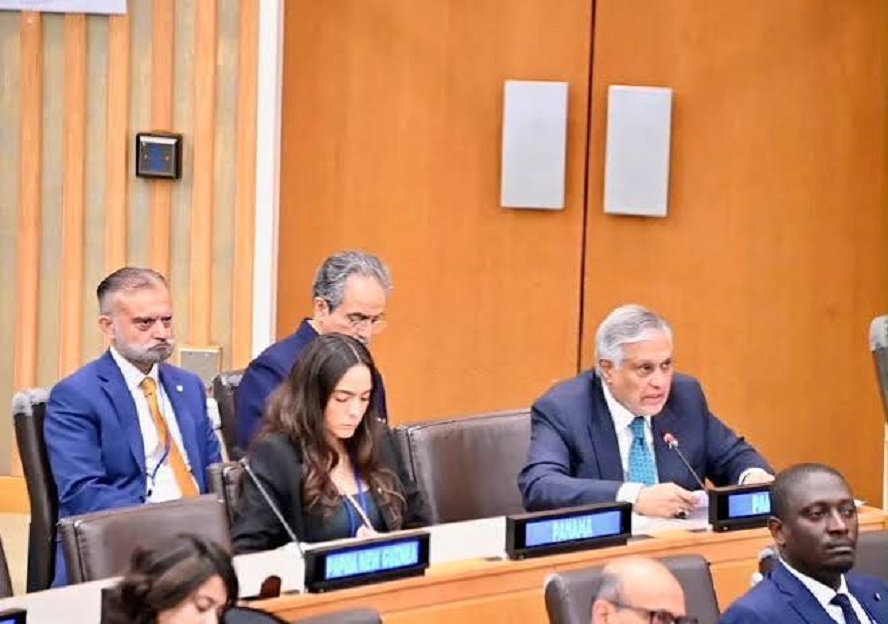
New York, (daily paklish): Deputy Prime Minister/Foreign Minister Senator Mohammad Ishaq Dar addressed the Annual Meeting of Foreign Ministers of the G-77 and China in New York.
He underscored the need for unity in safeguarding the development agenda and keeping it central to the UN.
Highlighting challenges facing developing countries, including debt burdens, constrained fiscal space, climate vulnerabilities, and widening technology gaps, the DPM/FM called for translating agreed commitments into tangible outcomes, including the implementation of the Sevilla Commitment and reform of the international financial architecture.
He stressed that emerging UN mechanisms on AI must bridge technological divides and ensure developing countries have a meaningful voice in global AI governance. He also called for an equitable outcome of international tax negotiations and reaffirmed the principles of equity and Common but Differentiated Responsibilities in global climate action.
The DPM/FM reaffirmed Pakistan’s commitment to working closely with G-77 and China to advance a more equitable international economic order and keep development at the heart of the UN agenda.
He said developing countries continue to confront constrained fiscal space, unsustainable debt burdens, declining concessional finance, climate vulnerabilities, and rapidly expanding technological divides.
He said these challenges are testing both the promise of multilateralism and our collective ability to deliver development at scale.
Against this backdrop, the Group must remain united in safeguarding the development agenda, preserving its centrality within the UN, and ensuring that agreed commitments translate into tangible outcomes.
First, we must sustain momentum on the implementation of the Sevilla Commitment. Important steps have been taken, including the convening of ECOSOC special meetings on financial integrity and credit rating agencies, and the launch of the Borrowers’ Platform for which Pakistan was pleased to serve as Vice-Chair of the Working Group. We must now advance the outstanding commitments, particularly: the intergovernmental process to address systemic gaps in the sovereign debt architecture; the establishment of a global debt registry and guiding principles on responsible sovereign borrowing and lending; scaling up MDB lending; and revitalization of the Development Cooperation Forum.
Second, ensure that the AI revolution does not deepen existing inequalities. The establishment of the Scientific Panel on AI and the Global Dialogue on AI Governance should integrate and strengthen the UN’s role in this domain. We must now ensure that these mechanisms bridge AI divides, build developing-country capacities, and secure our meaningful voice in global AI governance.
Third, restore momentum on the Sustainable Development Goals. We should strategically use the 2027 SDG Summit to shape the post-2030 agenda. For that, our Group must have a unified and coherent approach, as we did in 2015. We must ensure that any post-2030 framework remains firmly Member State-led and owned, and reflects the priorities of the Global South.
Fourth, advance negotiations on the UN Framework Convention on International Tax Cooperation towards an equitable outcome that strengthens domestic resource mobilization and gives developing countries a meaningful voice in global tax rule-making.
Lastly, equity and Common but Differentiated Responsibilities must remain at the heart of global climate action. Developed countries must fulfil their financing commitments, including tripling adaptation finance and the $300 billion annual goal, through concessional, grant-based, and accessible finance.