

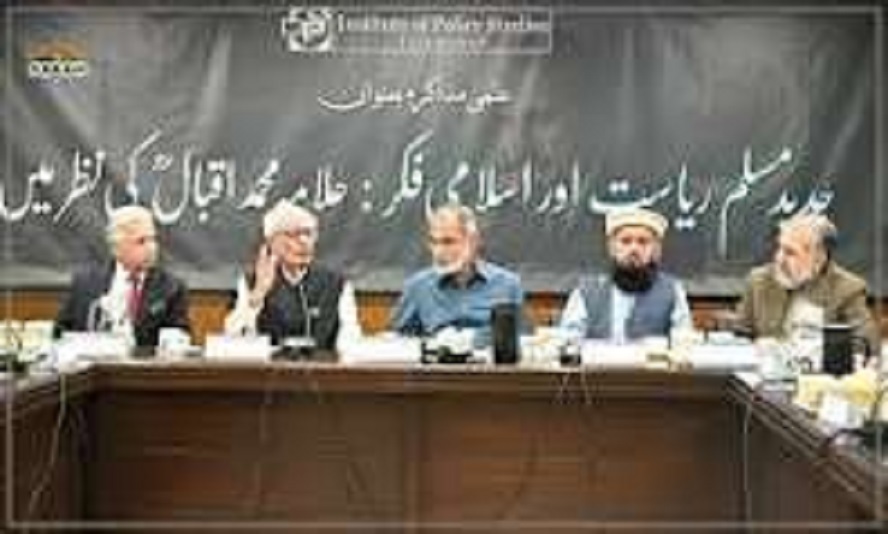
ISLAMABAD, (daily paklish): Allama Muhammad Iqbal’s political thought offers a framework for understanding an Islamic state through divine sovereignty, democratic participation, equality before the law, and social justice. His writings emphasize continuing intellectual engagement and collective reasoning in shaping an Islamic polity.
These ideas were explored during a session titled “Iqbal’s Conception of an Islamic Republic,” organized by the Institute of Policy Studies (IPS), which brought together prominent Iqbal scholars and experts on Islamic political thought.
The session featured Dr. Ikram ul Haq Yasin, former secretary, Council of Islamic Ideology; Prof. Fateh Muhammad Malik, former rector, International Islamic University;Dr. Khurshid Ahmad Nadeem, chairman,National Rahmatul-lil-Aalameen wa Khatamun Nabiyyin Authority; Dr. Zafar Hussain Zafar, Iqbal scholar; Khalid Rahman, chairman, IPS; Ambassador (retd) Syed Abrar Hussain, vicechairman, IPS; and Dr. Yasir Riaz.
Drawing on Iqbal’s writings on Islamic political thought, Dr. Ikram ul Haq Yasin placed his argumentsin the context of constitutional transformations taking place across the Muslim world. He explained that Iqbal regarded the Islamic political system as ijtihadi, open to human reasoning and deliberation in institutional matters,rather than tawqifi, with every detail of governance fixed by divine decree. He also discussed Iqbal’s interpretation of the early caliphate, particularly the role of public consent in selecting and holding leadership accountable.
Dr. Yasin further elaborated on Iqbal’s idea of a “Muslim Commonwealth” or Muslim Republic, in which multiple Muslim states could coexist under the rule of law. Its defining principles included equality before the law, rejection of privileged classes and hereditary rule, and the absence of a religious priesthood. He explained that Iqbal identified general Qur’anic principles, juristic interpretation, judicial decisions, and ijma as sources of legislation, associating the latter with democratic public opinion.
Building on this, Dr. Zafar Hussain discussed the development of Iqbal’s political ideas in relation to the debates of his time and the future of Muslims in the Subcontinent. Referring to the 1930 Allahabad Address and Iqbal’s correspondence with Quaid-e-Azam Muhammad Ali Jinnah in 1937-38, he highlighted Iqbal’s view that addressing Muslim poverty required a free Muslim state capable of giving practical effect to Islamic principles. Drawing on Iqbal’s writings and poetry, he identified Tawhid, ijtihad, and social justice as the three foundations of a modern Islamic welfare state.Participants discussed the relevance of Iqbal’s ideas to constitutional design, noting that consent, the social contract, accountability, and public criticism were present in Islamic political thought and were not merely Western imports. Regarding ijtihad and applying legal injunctions in changing circumstances, they emphasized original reasoning by qualified jurists, judges, and informed citizens, taking prevailing social conditions, or urf, into account.They further stressed the importance of studying Iqbal’s prose alongside his poetryto deepen understanding of his political, philosophical, and intellectual perspectives on the modern Muslim state.
In his remarks, Dr. Khurshid Ahmad Nadeem explained that Iqbal’s concept of spiritual democracy emerged from Tawhid, with political implications of equality, solidarity, and freedom. He noted that Iqbal sought to give spiritual meaning to modern institutions without advocating clerical rule. He described parliament as the contemporary expression of ijma and stressed collective ijtihad.
Chairing the session, Prof. Fateh Muhammad highlighted the continuing relevance of Iqbal’s thought to poverty, exploitation, and the condition of workers and peasants. He added that Iqbal’s attachment to the Prophet Muhammad (PBUH) was reflected in an ethical and social vision extending beyond ceremonial expressions of devotion.
In his concluding remarks, Ambassador (retd)Abrar Hussain reiterated that Iqbal’s essays addressed the idea of a general Muslim state. He observed that their central themes, particularly the relationship between religion and politics and the need for spirituality in civilizational life, remained evident throughout Iqbal’s prose and poetry.