

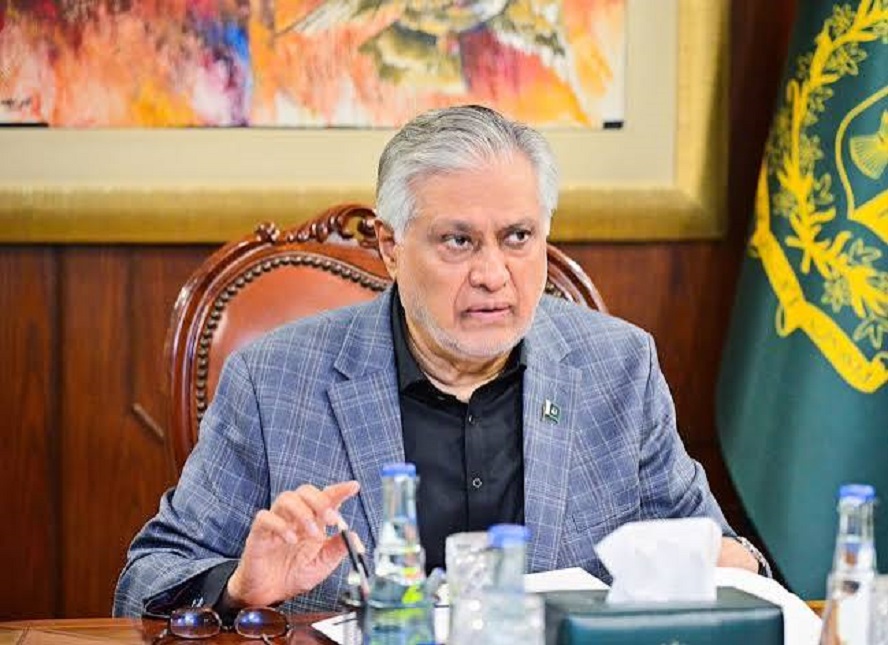
ISLAMABAD, (daily paklish): Deputy Prime Minister/Foreign Minister Senator Mohammad Ishaq Dar has said Pakistan will firmly safeguard its legitimate rights under the Indus Waters Treaty and oppose any attempt to weaponize water.
Addressing the Inaugural Session of Margalla Dialogue 2026 in Islamabad on Tuesday, Ishaq Dar emphasized that regional stability also depends on respect for the treaty obligations.
The Deputy Prime Minister said the just resolution of Jammu and Kashmir dispute in accordance with the UN Security Council resolutions remains indispensable for lasting peace in South Asia. He said leaving the dispute unresolved perpetuates mistrust and exposes the region to recurring crises.
Ishaq Dar recalled Pakistan’s decisive and calibrated response to India’s unprovoked aggression in May last year, saying it demonstrated our readiness and capability to defend our sovereignty. He said our position is very clear that we will defend our sovereignty with determination and pursue peace with equal commitment.
Ishaq Dar highlighted that terrorism emanating from Afghanistan remains a serious security challenge. He said Pakistan will continue to protect its people while supporting efforts towards a peaceful, stable and economically integrated Afghanistan. He, however, said progress towards this objective requires effective action to ensure that the Afghan territory is not used for terrorism against other countries, particularly Pakistan.
As regards the US-Iran conflict, the Deputy Prime Minister said Pakistan continues to pursue all diplomatic efforts to sustain engagement, restore dialogue and facilitate a return to the negotiating table. He emphasized that the Islamabad MoU provides an important foundation for further negotiations.
The Deputy Prime Minister said Pakistan remains committed to an equitable international order, anchored in the UN Charter, sovereign equality, territorial integrity and peaceful settlement of disputes. He said Pakistan has leveraged the membership of the UN Security Council to translate these principles into concrete action.
Ishaq Dar said Pakistan’s strategic partnership with China remains a cornerstone of our foreign relations. He said Pakistan continues engagement with the US and is strengthening cooperation with Saudi Arabia, Türkiye, Egypt, Iran, the Gulf, Europe, Central Asia and other partners.
The Deputy Prime Minister said Makkah Joint Defense Agreement with Saudi Arabia and Türkiye reflects our commitment to collective security and credible deterrence. He said it is a defensive agreement directed against no country and intended to contribute to regional peace and security.
Ishaq Dar said “I commend the Islamabad Policy Research Institute for convening this important platform for discussion on the challenges shaping our region and the world. The theme, “Global Order in Transition: Navigating Strategic Uncertainty”, poses a question of direct consequence for Pakistan: as the global order undergoes profound change, how can we safeguard our security and build a more prosperous future for our people? The answer lies in strength at home and effective diplomacy abroad, both serving one purpose: the security and prosperity of our people”.
Ishaq Dar said that the shape of the emerging world order remains uncertain. Yet the choices countries make during this transition will help determine whether it produces greater cooperation or deeper confrontation. Three developments deserve particular attention. First, the international security architecture faces mounting pressure. Intensifying great-power rivalries, protracted conflicts and the erosion of arms control arrangements are increasing the risks of confrontation and miscalculation. Growing reliance on military instruments is narrowing the space for diplomacy precisely when that space needs to expand.
Ishaq Dar said that multilateral institutions, particularly the United Nations, are constrained by political divisions. Selective application of international law further weakens confidence in the institutions established to uphold it. When agreed principles are applied inconsistently, their authority suffers, and every country becomes less secure. Second, geopolitics, economics and finance are becoming more closely intertwined. Trade, technology, energy and access to capital are increasingly shaped by strategic competition. Instability in the Gulf and the Red Sea illustrates how quickly a regional crisis can disrupt trade and energy supplies, sending shockwaves through the global economy. Third, rapid technological advances are creating opportunities while introducing risks that existing institutions are struggling to address. Artificial intelligence, cyber capabilities, biotechnology and outer-space technologies are changing how states compete and how conflicts may unfold. They also raise difficult questions about accountability and the rules governing their use.
Ishaq Dar said that the defining feature of this environment is the way these challenges reinforce one another. A security crisis can become an economic shock. That shock can raise food and fuel prices, threaten livelihoods and place public services under further pressure. Our policies must recognise how quickly a crisis in one domain can spread into others.
Ishaq Dar said that amid these changes, a fundamental question remains: what kind of international order will emerge from this transition? Pakistan believes that a more representative multipolar order can give a wider range of countries a meaningful voice in international affairs. But a wider distribution of power will not, by itself, produce a fairer or more peaceful world. That requires effective multilateralism, representative institutions and respect for agreed rules. He said that without these foundations, multipolarity risks becoming another setting for rivalry and fragmentation.
Ishaq Dar said that Pakistan therefore remains committed to an equitable international order anchored in the UN Charter, sovereign equality, territorial integrity and the peaceful settlement of disputes. These principles provide countries with a measure of security and predictability when the balance of power is changing. The notion that “might is right” is gaining ground, as the use of force increasingly displaces respect for law. Palestine offers a stark illustration. The suffering in Gaza, the continued occupation and the expansion of illegal settlements demonstrate the human cost of impunity.
Ishaq Dar said that Pakistan leveraged its 2025 and 2026 membership of the United Nations Security Council to translate these principles into concrete action. During our Presidency in July 2025, the Council unanimously adopted Pakistan-initiated Resolution 2788 on strengthening mechanisms for the peaceful settlement of disputes. Building on this initiative, the Council adopted by consensus a Pakistan-initiated Presidential Statement on 5 November 2026, reaffirming the importance of sustained diplomacy, mediation and dialogue even during active hostilities.
Ishaq Dar said that the relevance to our discussion today is clear. In periods of strategic uncertainty, the international community needs reliable means to prevent disputes from escalating and to bring conflicts towards a peaceful resolution.
He said that Pakistan’s regional diplomacy follows the same conviction. Our facilitation of the Islamabad Talks between the United States and Iran in April this year reflected that approach. The subsequent Islamabad Memorandum of Understanding provides an important foundation for further negotiations.
Ishaq Dar said that Prime Minister Muhammad Shehbaz Sharif and Chief of Defence Forces and Chief of Army Staff, Field Marshal Syed Asim Munir, and the Foreign Office of Pakistan have remained closely engaged in these efforts. Their sustained engagement has been an important part of Pakistan’s work to facilitate dialogue and advance regional peace. Our diplomatic efforts have also involved close coordination with China. During my one-day visit on 31 March 2026 in Beijing, Pakistan and China jointly issued the Five-Point Initiative for Restoring Peace and Stability in the Gulf and Middle East Region, underscoring our shared commitment to a peaceful resolution through dialogue and diplomacy.