

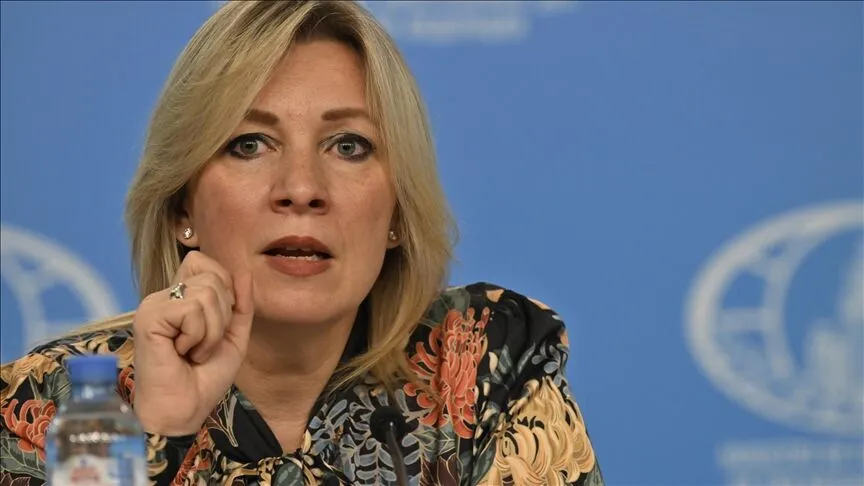
MOSCOW, Daily Paklish: Russian Foreign Ministry Spokeswoman Maria Zakharova while responding to the anti-Russian statements by the Japanese leadership has said that the statements by Japanese Prime Minister Sanae Takaichi and Foreign Minister Toshimitsu Motegi, circulated on August 13, concerning President of Russia Vladimir Putin’s visit to Iturup Island – which, like all the Kuril Islands, is an integral part of our country on legitimate grounds – are deeply outrageous and absolutely unacceptable.
Maria Zakharova said that senior Japanese officials have gone so far as to lecture Moscow on which regions of its own country its Head of State may or may not visit. Maria Zakharova said we categorically reject these remarks as politically irrelevant, insulting and, of course, legally null and void.
She said that the latest attacks on Russia by the Japanese leadership are yet another manifestation of official Tokyo’s short-sighted policy, which has opted for a course bordering on outright hostility towards Russia.
Maria Zakharova said that by joining the illegitimate Western sanctions against our country and supporting – including militarily and technically – the Nazi regime in Kiev, which seeks to eradicate everything Russian, Japan is effectively destroying Russia-Japan relations at their very foundations – relations that Russia and responsible Japanese political leaders had worked hard to build over the past decades.
Maria Zakharova said that accordingly, official Tokyo, which has violated every legal norm through its complicity in the Russophobic policy of the “collective West”, including by imposing unlawful restrictions, is hardly in a position to lecture others on international law or on the need to care about the future of Russia-Japan relations.
Maria Zakharova it is equally clear that such a policy towards a neighbouring country does not serve the interests of the Japanese people, whose sentiments the Japanese leadership seeks to invoke.
He said that in short, Tokyo remains trapped in an imaginary reality divorced from the actual state of affairs. We recall in this connection that the southern Kuril Islands became part of our country following World War II, pursuant to agreements among the Allied Powers and the UN Charter.
She said that Russia’s sovereignty and jurisdiction over them are not subject to question. She said that the most odious and dangerous element of the “messages” from Sanae Takaichi and Toshimitsu Motegi – for all of Japan’s neighbours and the Asia-Pacific region as a whole – is the revanchism permeating these statements.
Maria Zakharova said that we are compelled to note that almost 81 years after Japan signed the Instrument of Unconditional Surrender in September 1945, Tokyo is once again gripped by revisionist narratives aimed at whitewashing its aggression in Asia and advancing absurd claims against Russia.
She said that it is obvious that this short-sighted policy runs counter to the efforts of most countries in the region to promote peace, security and cooperation, thereby creating serious risks for the people of Japan.
Meanwhile Maria Zakharova while replying the question of media regarding Turkish Foreign Minister Hakan Fidan’s statement on a proposal for Russia and Ukraine to introduce a moratorium on military activities in the Black Sea.
Question: Has the Russian Side received Turkiye’s proposal to introduce a moratorium on military activities in the Black Sea, and is it prepared to consider such an option?
Maria Zakharova: We traditionally give careful consideration to all peace initiatives put forward by our foreign partners, especially by Turkiye, which is an important regional player and our neighbour on the Black Sea.
Turkiye’s Foreign Minister Hakan Fidan recently said in a media interview that Ankara had conveyed proposals to the Russian and Ukrainian sides on introducing a moratorium on military activities in the Black Sea.
The Russian Side has not received through official channels any formal Turkiye’s proposal setting out the specific terms of this initiative.
If this refers to a one-sided arrangement along the lines of the 2022-2023 scheme, better known as the Black Sea Initiative, under which Moscow suspended military activities in the Black Sea – more precisely, retaliatory measures to protect Russian port infrastructure and energy facilities – then returning to that format would be inadvisable.
The arrangement was conditional on reciprocal measures by the other side. Those measures never followed.
At the time, as you may recall, we agreed to the moratorium in exchange for access for Russian agricultural products to global markets.
However, the West demonstrated a bad-faith approach: the humanitarian corridor we provided came to be widely used for terrorist attacks against Russian civilian and military facilities, while Russian agricultural products remained under sanctions. This ultimately led to the termination of the Black Sea Initiative.
Maria Zakharova said that today, we regularly face brazen acts of terrorism carried out by Ukrainian drones in the Black Sea against civilian vessels from coastal states, several times a month. We regard these attacks as a deliberate policy aimed at destabilising civilian shipping in the Black Sea region, further escalating tensions and prolonging the conflict, with the open acquiescence of neighbouring countries in the region.
At the same time, we see no prerequisites for the situation to improve and, consequently, no grounds for half-measures that merely give the Kiev regime a temporary respite.
We have recently seen a growing number of international calls for a ceasefire and for settling the situation around Ukraine through familiar short-term arrangements.
Our position on these proposals and on the issue as a whole remains unchanged. A sustainable and long-term settlement of the Ukrainian crisis is possible only if its root causes are eliminated.
First and foremost, this means removing the security threats created by NATO’s eastward expansion and attempts to draw Kiev into the alliance.
It is equally important to secure guarantees for the restoration and observance of the legitimate rights of the Russian and Russian-speaking population in the territories that remain under the control of the Kiev regime.